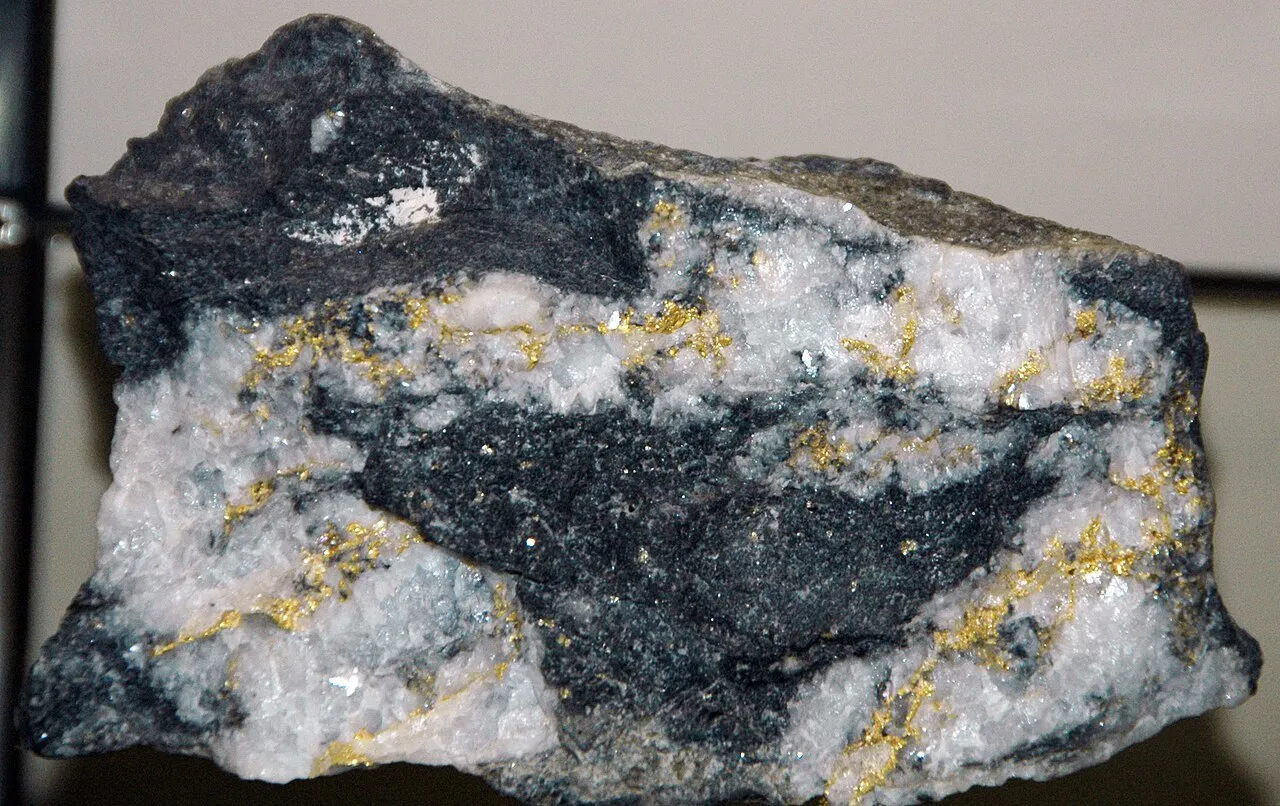
Bright threads of gold running through milky white quartz: few natural objects say “gold rush” quite so clearly. Gold quartz specimens are pieces of the very veins that fed the world’s placer deposits, and collectors prize them for exactly that reason. Here is how gold ends up in quartz, how to read a specimen, how to estimate how much gold it actually contains, and what to watch for before you buy or display one.
In brief
- A gold quartz specimen is a piece of hydrothermal vein: native gold deposited together with quartz from hot fluids deep in the Earth’s crust.
- The gold can form wires, leaves, crystals, sponges or fine specks; its shape and contrast with the quartz drive a specimen’s appeal as much as its weight.
- The proportion of gold can be estimated with a specific gravity test, but only as an approximation.
- Watch for resin-filled, glued or painted fakes, and never try to “clean” a specimen with acid.
How gold ends up in quartz
Most of the world’s hard-rock gold formed in what geologists call orogenic or mesothermal gold deposits. During mountain building, hot, water-rich fluids circulate through faults several kilometers below the surface. These fluids carry dissolved silica and tiny amounts of gold. When pressure or temperature drops, or when the fluid reacts with the surrounding rock, silica crystallizes as quartz and gold comes out of solution at the same time. The result is a quartz vein with gold scattered through it, often alongside sulfide minerals such as pyrite and arsenopyrite.
Over millions of years, erosion breaks these veins down. The quartz is carried away and ground into sand, while the heavy gold collects in stream gravels. That is why a quartz specimen and a placer nugget are two chapters of the same story, as our guide to how gold nuggets form explains. Many nuggets still carry small grains of quartz from their parent vein.
Famous gold quartz districts
- California’s Mother Lode: the belt of gold-quartz veins along the western Sierra Nevada foothills, worked after the California Gold Rush, produced classic specimens of white quartz with leafy and crystalline gold.
- Victoria and New South Wales, Australia: the quartz reefs of Bendigo and Ballarat, and the Holtermann specimen found at Hill End in 1872, usually cited at about 286 kg of quartz and gold, the largest single mass of gold-bearing quartz ever recorded.
- Western Australia: the Yilgarn region, source of much of today’s Australian gold, including specimens recovered by detecting weathered vein material.
- Other classic sources: Colorado, Brazil, and historic districts in Canada’s Yukon and British Columbia.
How to read a gold quartz specimen
The form of the gold
Gold in quartz rarely looks like a nugget. It fills cracks and cavities, so it often appears as thin leaves (plates following a fracture), wires and dendrites (branching, tree-like growths), sponges filling a cavity, or scattered specks. In open pockets, gold can grow as small crystals, which collectors value highly; our guide to natural gold crystals describes the main forms. A specimen where the gold is clearly visible on several faces is generally more desirable than one where it hides inside the rock.
The quartz and the matrix
Vein quartz is usually white to gray and massive, sometimes stained orange or brown by iron oxides where sulfides have weathered. Some specimens keep a band of dark host rock (slate, schist or greenstone), as in the Amador County piece pictured above. That contrast between yellow gold, white quartz and dark matrix is part of what makes a good specimen striking. Rusty “boxwork” cavities, left where pyrite has dissolved, are a common and natural feature.
Rough, cut or polished
Specimens are sold either in their natural, rough state or cut and polished, sometimes into slabs or cabochons for jewelry. Polishing makes the gold pattern easier to see, but it removes the natural surfaces and any crystals. Neither form is “better”; they appeal to different buyers. What matters is that the seller says clearly which one you are getting, and whether any filler has been used to stabilize fractures.
How much gold is in a specimen?
Because quartz is light and gold is very heavy, the overall density of a specimen reveals roughly how much gold it contains. The method uses the same hydrostatic weighing described in our guide on how to tell a real gold nugget.
- Weigh the specimen in air (W).
- Weigh it fully submerged in water, hanging from a thread so it does not touch the container (Ww).
- Calculate the specimen’s specific gravity: SG = W ÷ (W − Ww).
- Estimate the gold weight with the two-component formula: gold weight ≈ W × [SGgold × (SG − SGquartz)] ÷ [SG × (SGgold − SGquartz)].
Quartz has a specific gravity of about 2.65. Native gold ranges from roughly 15 to 19 depending on its silver content (see gold nugget purity); a value around 17 is a common working assumption. For example, a 50 g specimen with a measured SG of 4.0 would contain, by this formula, about 20 g of native gold.
Treat the result as an estimate, not an assay. The formula assumes the specimen contains only gold and quartz. Dark host rock, iron oxides and sulfides (pyrite has an SG of about 5) all raise the density and lead to an overestimate; trapped air in cavities lowers it. A small kitchen scale is also too imprecise for specimens of a few grams. For a significant piece, a reputable seller should state how the gold content was estimated.
Spotting fakes and enhancements
- Pyrite or chalcopyrite in quartz: brassy, brittle, and often in neat cubes or crystals. Gold is soft, keeps its color from every angle and never forms cubes. See fool’s gold vs. real gold.
- Glued or embedded gold: flakes or small nuggets set into quartz with epoxy. Look under magnification for glossy resin, bubbles or a sharp boundary where the gold meets the quartz; natural gold interlocks with the quartz crystals.
- Painted or plated material: metallic paint wears off on edges and looks uniform in color. Natural gold shows slight variations in tone and texture.
- Undisclosed stabilization: fractured quartz is sometimes impregnated with resin before cutting. That is acceptable if declared, but it should be disclosed.
Mica can also glitter in quartz like tiny gold flakes. It is flaky, splits into thin sheets and loses its shine when the angle changes.
Caring for a gold quartz specimen
- Dust with a soft brush; if needed, rinse in lukewarm water with a drop of mild soap and let it air-dry.
- Avoid ultrasonic cleaners: vibration can open existing fractures in quartz.
- Never use acids. Commercial processors dissolve quartz with hydrofluoric acid, an extremely dangerous chemical that has no place in a home. Light iron staining is natural and many collectors leave it.
- Store the piece on a padded surface, away from harder minerals that could scratch the gold. More advice is in our guide on how to clean and store gold nuggets.
What to ask for when buying
- Photographs of the exact specimen, from several sides.
- The total weight to the hundredth of a gram, and how any gold content was estimated.
- The locality, at least country and region.
- Whether the piece is natural, cut or stabilized, recorded on a certificate of authenticity.
The price of a gold quartz specimen reflects its aesthetics, gold content and locality, not just the metal it contains, as our guide on gold nugget prices explains. Specimens are collectibles, and this guide is not investment advice. Every Aurum Native gold-in-quartz piece is photographed and weighed individually and sold with its certificate. Discover our gold in quartz specimens.
Frequently asked questions
Is gold in quartz worth more than a nugget of the same weight?
Not automatically. Part of a specimen’s weight is quartz, so it contains less gold than a solid nugget of the same weight. On the other hand, attractive specimens with well-displayed gold are scarce and can be valued by collectors well beyond their gold content. Each piece has to be judged on its own.
Can a metal detector find gold in quartz?
Yes, if the gold is concentrated enough and close to the surface. Many Australian specimens were found this way in weathered ground. Finely disseminated gold may not produce a signal. See our guide to metal detecting for gold.
Does all white quartz contain gold?
No. Quartz is one of the most common minerals on Earth, and the vast majority of quartz veins carry no visible gold. Gold-bearing veins occur in specific geological settings, and even there, visible gold is the exception.
Why is some gold quartz stained orange or brown?
The color usually comes from iron oxides formed when sulfide minerals in the vein weathered. It is a natural feature, often found in gold-bearing veins, and it does not affect the gold itself.
Sources
- US Geological Survey, orogenic (mesothermal) gold deposits and the Mother Lode gold belt.
- Mindat.org, mineral data for gold, quartz and pyrite (specific gravity).
- Geological Survey of New South Wales, Hill End goldfield and the Holtermann specimen.
- Geological Survey of Victoria, Bendigo and Ballarat quartz reef goldfields.