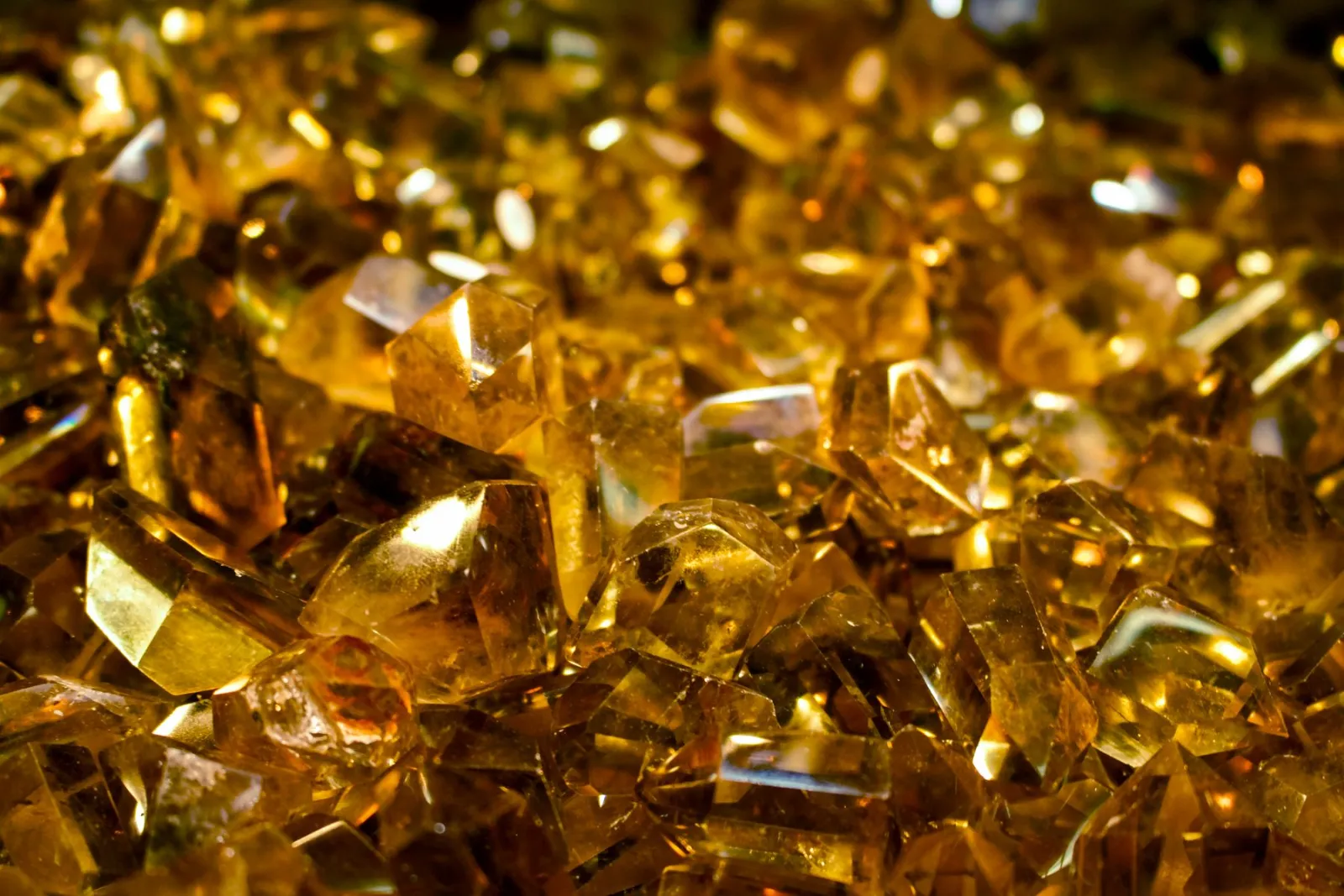
A natural gold crystal is one of the rarest forms in which native gold occurs. Where a nugget has been tumbled and hammered by rivers, a crystal has kept the geometric faces it grew in the vein. Here is how gold crystallizes, the forms it can take, and how to recognize and care for these pieces, so sought after by collectors.
At a glance
- Gold crystallizes in the cubic system : its crystals derive from the octahedron, the cube and, more rarely, the dodecahedron.
- The most common forms are the octahedron, the hopper crystal with recessed faces, dendrites, leaf gold and wire gold.
- These crystals form in open cavities within veins and do not survive long transport in a river.
- Fragile and rare, they must be handled with care and are often worth far more than the gold they contain.
How gold crystallizes
At the atomic scale, gold is arranged in a face-centered cubic lattice: each atom sits at a corner or at the center of a face of a tiny cube, repeated billions of times. This structure, shared with silver and copper, explains both the metal’s great malleability and the geometry of its crystals. The possible external forms are those of the cubic system: the octahedron with eight triangular faces, the cube with six square faces, the rhombic dodecahedron with twelve diamond-shaped faces, and their combinations.
The crystal still needs room to grow. In most veins, gold is deposited in narrow fractures, wedged between quartz grains, and takes irregular shapes, grains or platelets, as explained in our guide on how a gold nugget forms. Well-formed crystals appear when hydrothermal fluids circulate through an open cavity, a vug or pocket in the vein, and gold slowly precipitates on its walls. The rate of deposition, the temperature and the amount of gold available then determine the resulting form.
Slow growth or fast growth
When deposition is slow and steady, atoms have time to arrange themselves evenly on every face, producing compact crystals with flat faces, such as the octahedron. When deposition is rapid, the edges and corners, better supplied with fluid, grow first. The centers of the faces lag behind and become hollow: this is skeletal growth, the origin of hopper crystals and dendrites.
The main forms of crystalline gold
The octahedron
This is the most common crystal form of gold: two square-based pyramids joined at the base, giving eight triangular faces. Perfect octahedra remain small, from a millimeter to a centimeter, and often show slightly rounded corners or striated faces. They are frequently twinned : two crystals join along a shared face, producing flattened triangular or star-shaped forms. Twinning explains the small triangular gold plates seen on some specimens.
The hopper crystal
A hopper crystal keeps the outline of the octahedron or cube, but its faces are recessed in steps, like a funnel. This stepped relief, clearly visible under a loupe, is the signature of rapid growth along the edges. The most extreme forms, known as skeletal crystals, retain only the framework: a lattice of golden edges surrounding almost empty faces. They are among the most striking pieces of crystalline gold.
Dendrites and arborescent gold
When skeletal growth continues in a preferred direction, the crystal branches out. It forms branches reminiscent of a fern leaf or a small tree; this is called dendritic or arborescent gold. Each branch is in fact a row of tiny crystals oriented in the same direction, and small octahedral points can often be seen at the tips.
Leaf gold
Leaf gold, or lamellar gold, occurs as thin plates, sometimes barely thicker than a sheet of paper, that developed in flat fractures within the vein. Their surface often bears a pattern of triangles or crossed striations, traces of the octahedral faces. Very light for their size, these pieces offer a large golden surface for a modest weight.
Wire gold
Wire gold forms threads, straight, twisted or tangled like a skein. Its growth is less well understood than that of other forms; it is found mainly in cavities where gold was deposited from one end, extending like a lengthening thread. Well-exposed wire gold specimens are among the rarest pieces on the mineral market.
Where are gold crystals found?
Gold crystals come from primary deposits, meaning the veins themselves, or from placers that remained very close to their source. A few hundred yards of river transport is enough to crush the edges and close the hollows: a tumbled crystal becomes a nugget like any other. A few regions are well known to collectors:
- Western Australia and Victoria : the great goldfields regularly yield crystalline gold from very old terrain, described in our guide to Australian gold.
- California : the Eagle’s Nest Mine in Placer County is famous for its leaf and wire gold.
- Nevada : the Round Mountain deposit has produced remarkable plates of crystalline gold.
- Venezuela and the Guiana Shield : well-formed octahedra and twinned crystals have been found there.
In France and most of Western Europe, river gold occurs almost exclusively as fine flakes, and gold crystals visible to the naked eye are exceptional.
Recognizing a genuine gold crystal
Do not confuse it with pyrite
Pyrite also forms handsome, bright yellow crystals, sharp cubes or dodecahedra with pentagonal faces, often much larger than gold crystals. It is hard (6 to 6.5 on the Mohs scale, versus 2.5 to 3 for gold), brittle and about four times less dense. A pyrite crystal several centimeters across is common; a gold crystal of the same size would be a museum piece. Our guide on how to tell a real gold nugget details simple tests that apply to every form of native gold.
Signs of natural growth
- Distinct flat faces and regular angles, consistent with the octahedron or cube, even when incomplete.
- Fine steps, striations or triangles on the surface, visible under a loupe.
- Sometimes remnants of quartz or iron oxides at the base, traces of the original cavity.
- A color that varies with silver content: deep yellow for rich gold, paler for silver-bearing gold.
Laboratory-grown synthetic gold crystals also circulate. They are generally very pure, perfectly regular and show no trace of host rock. For an important piece, a composition analysis and documented provenance remain the best guarantees; our page on the certificate of authenticity explains what it should state.
Why a gold crystal is worth more than its weight
The metal value of a gold crystal is calculated like that of any nugget, from its weight, purity and the gold price. For a crystal, however, that value is only a starting point. The rarity of the form, the sharpness of the faces, the absence of damage, the size of the individual crystals and the overall aesthetics weigh far more. A small hopper crystal of a few grams can command several times the value of its gold. The reasons for this premium are explained in our guide on gold nugget prices. This information is provided for reference only and does not constitute investment advice.
Handling and storing a gold crystal
Gold is a soft metal: the pressure of a finger is enough to bend a dendrite branch or crush the edge of a hopper. A few precautions preserve the piece:
- Hold the specimen by its base or host rock, never by the crystals themselves.
- Keep it in a rigid case, ideally on a mount or foam insert that holds it still.
- Avoid brushes, cloths and ultrasonic cleaners: a simple rinse in water is usually enough.
- Examine it under a loupe or raking light to bring out the faces.
Our full advice is in the guide on how to clean and store a gold nugget. To see these forms up close, every specimen in our selection of gold crystals is individually photographed, weighed and described, with its provenance.
Frequently asked questions
What is the difference between a gold crystal and a nugget?
Both are native gold. A crystal has kept the geometric faces of its growth, whereas a nugget has been deformed and rounded by erosion and transport. A so-called crystalline nugget combines a mass of gold with crystal faces that are still visible.
How large can a gold crystal be?
Individual crystals usually measure from a few tenths of a millimeter to one or two centimeters. Larger specimens are generally aggregates of many crystals, plates or dendrites, rather than a single crystal.
Is a gold crystal pure gold?
No. Like every form of native gold, it contains silver and traces of other metals. Its purity depends on the deposit; a crystal assaying 99.9% with no host rock at all should suggest a synthetic origin.
Can a gold crystal be worn as a pendant?
It is possible with compact crystals, such as some octahedra, provided they are protected by a suitable setting or bail. Fine forms, dendrites, wires or skeletal hoppers, are too fragile to be worn and are best kept for display.
Sources
- Anthony J. W. et al., Handbook of Mineralogy, vol. I, “Gold,” Mineralogical Society of America.
- Klein C. and Dutrow B., Manual of Mineral Science, Wiley, 23rd edition, 2007.
- Mindat.org, “Gold” mineral page.
- U.S. Geological Survey, “Gold” (mineral commodity profile and gold deposits).