Gold does not rust, does not tarnish and passes through the centuries unaltered. A gold nugget therefore needs very little care, but that little must be done well: native gold is a soft metal, and overly vigorous cleaning can erase in minutes a surface shaped over millions of years. Here is how to clean a gold nugget without damaging it, what never to do, and how to store or display it so that it keeps its full character.
At a glance
- To clean a gold nugget, lukewarm water, a drop of mild soap and a soft brush are enough in the vast majority of cases.
- Never polish it : its natural texture is what gives the piece its value and authenticity.
- Avoid acids, mercury and abrasives entirely; chemical treatments are a matter for professionals.
- Store each piece separately, in a box or vial, with its invoice and certificate close at hand.
Why a nugget needs so little care
Gold is a noble metal: it does not react with oxygen in the air, with water, or with most common acids. That is why a nugget emerges intact from the rock after millions of years of erosion, as explained in our guide How Gold Nuggets Form. At home, it will not oxidize or change color.
There are two qualifications, however. First, native gold is never pure: it contains silver and sometimes a little copper. A silver-rich nugget may, over time, develop a very faint surface film, with no consequence for its value. Second, what soils a nugget is not the gold itself but what surrounds it: dust, fingerprints, residues of clay or iron oxides lodged in the hollows and, for gold-in-quartz specimens, the host rock itself.
A soft metal that scratches easily
On the Mohs scale, which ranks minerals by hardness, gold sits between 2.5 and 3: barely harder than a fingernail, well below a steel blade or quartz (7). In practice, a nugget can be scratched by another nugget, a key, a coin, even by grains of sand rubbed across its surface. Its malleability, which lets it bend without breaking in rivers, also makes it sensitive to impact: a fine point or a dendrite can bend if the piece is dropped.
All good practice follows from these two properties: gold has nothing to fear from gentle chemistry, but it does fear friction and impact.
How to clean a gold nugget, step by step
For a solid nugget, with no quartz or fragile parts, the following gentle method is almost always suitable:
- Prepare a bowl of lukewarm water with a drop of mild dish soap. Work over a folded towel, never over an open sink: a small nugget slips easily down a drain.
- Let it soak for a few minutes to soften dust and greasy deposits.
- Brush gently with a soft paintbrush or a very soft toothbrush, working into the hollows without pressing.
- Rinse in clean water, ideally distilled water, which leaves no mineral spots as it dries.
- Dry by patting with a clean microfiber cloth, then let the piece finish drying in the open air, resting on a cloth.
For a piece that is merely dusty, a photographer’s air blower or a dry brush is enough. The less a nugget is handled, the better.
Nuggets with quartz and gold crystals
Gold-in-quartz specimens and gold crystals call for even more restraint. Quartz can contain invisible fractures, and gold crystals, wires and dendrites are so fine that a single stroke of a brush can bend them. For these pieces, limit yourself to dusting with an air blower or a very soft brush. A bath in soapy water remains possible for a dirty specimen, provided the delicate parts are not brushed and the piece is left to dry thoroughly: water trapped in the fractures of the host rock can leave marks.
What about an ultrasonic cleaner?
Ultrasonic cleaners, used by jewelers, are effective at lifting dirt from hollows. They are generally suitable for a solid gold nugget. Their vibrations can, however, widen fractures in quartz, detach gold from its host rock or break fine crystals: avoid them for any specimen combined with another mineral or with fragile parts.
What never to do
| Avoid | Why |
|---|---|
| Polishing, buffing, using silver polish | Erases the natural texture, gives a “worked” look that casts doubt on authenticity and reduces interest for collectors |
| Wire brushes, scouring powder, toothpaste | Abrasives: they scratch gold, which is much softer |
| Acids (including household descalers) | Useless on gold, they can attack associated minerals and are hazardous to handle |
| Mercury, or objects containing it | Mercury amalgamates with gold and leaves a lasting gray stain |
| Bleach, chlorine-based products | Of no benefit to gold and harsh on other metals and minerals |
| Heating the piece or passing it through a flame | Can crack quartz and alter the surface appearance |
Brown or rust-colored stains: should they be removed?
Many nuggets carry a brown, ocher or reddish patina in their hollows. These are iron oxides from the weathering of the sulfides that accompanied the gold in its vein. The patina is part of the piece’s history, and many collectors prefer to keep it. Chemical treatments exist to remove it, and others to dissolve the quartz surrounding the gold; they involve hazardous, sometimes highly toxic products and are strictly a matter for equipped professionals. They also alter the original appearance of the piece. For a nugget you have purchased, our advice is simple: leave it as it is.
Handling a nugget without damaging it
- Hold it by the edges, over a table covered with a cloth, never over empty space.
- Have clean, dry hands, or wear thin cotton or nitrile gloves for a collector’s piece.
- Remove your rings : the metal of a ring or a set stone easily scratches native gold.
- Do not pass it from hand to hand around a table: that is when pieces get dropped.
Storing a gold nugget properly
The golden rule of storage is never to let several pieces knock against one another. A compartment box, a foam-lined case or a small glass-topped box with a soft base are ideal. For very small nuggets and nugget lots, prospectors traditionally use small glass or plastic vials; some fill them with water, which visually magnifies the gold. Simply avoid mixing in one vial pieces you wish to identify separately.
Gold is unaffected by light or ambient humidity. Quartz and other associated minerals, however, do not tolerate sudden temperature changes well: choose a temperate room rather than a sunny windowsill or a spot near a radiator.
Displaying your nugget
A glass dome, a small display cabinet or a foam-based box under a clear lid protects the piece from dust while keeping it visible. Place it on a stable base, away from the edges of shelves: a nugget is small and heavy for its size, as our guide Gold Nugget Size and Weight points out, and a fall onto a tiled floor can flatten an edge or bend a raised feature. Warm, low-angle lighting brings out the relief and color of native gold.
Documents and security
Keep the invoice and the certificate of authenticity for each piece, and take a few sharp photographs of the nugget yourself, from several angles and next to a ruler. These records make it possible to identify a unique piece in case of loss, damage or inheritance. For a piece of significant value, ask your insurer about the terms of coverage for valuables kept at home, as they vary from policy to policy. Finally, store the nugget somewhere discreet rather than in plain view near an entrance.
A nugget worn as a pendant: separate care
A nugget mounted as a pendant leads a different life: it rubs against clothing, skin and other jewelry. Its most prominent features gradually soften, which is normal for a piece that is worn. To preserve it, remove the pendant for sports, gardening, swimming and household chores, and store it separately from other pieces. Cleaning remains the same: lukewarm soapy water and a soft brush. Have the bail or setting checked regularly by a jeweler: native gold being soft, a loosening clasp or prong can let the nugget slip free.
Every piece in the collection is delivered clean, exactly as photographed, with no polishing or treatment. Discover our gold nuggets.
Frequently asked questions
What should I use to clean a gold nugget?
Lukewarm water, a drop of mild dish soap and a soft paintbrush or very soft-bristled brush. Rinse with distilled water and pat dry with a microfiber cloth.
Can a gold nugget darken or tarnish?
Gold itself does not oxidize. A silver-rich nugget may develop a faint film over time, and the hollows can collect dust and deposits; gentle cleaning is enough to restore its luster.
Can a gold nugget be polished to make it shine?
It is not recommended. Polishing erases the natural texture that makes the piece beautiful, gives it an artificial look and can cast doubt on its authenticity, as explained in our guide How to Tell a Real Gold Nugget.
Does cleaning affect the value of a nugget?
Gentle cleaning does not. Polishing, chemical treatment or a deep scratch, on the other hand, can reduce a piece’s appeal to collectors, and therefore the part of its price above metal value, detailed in our guide on gold nugget prices.
How should I clean gold found by panning?
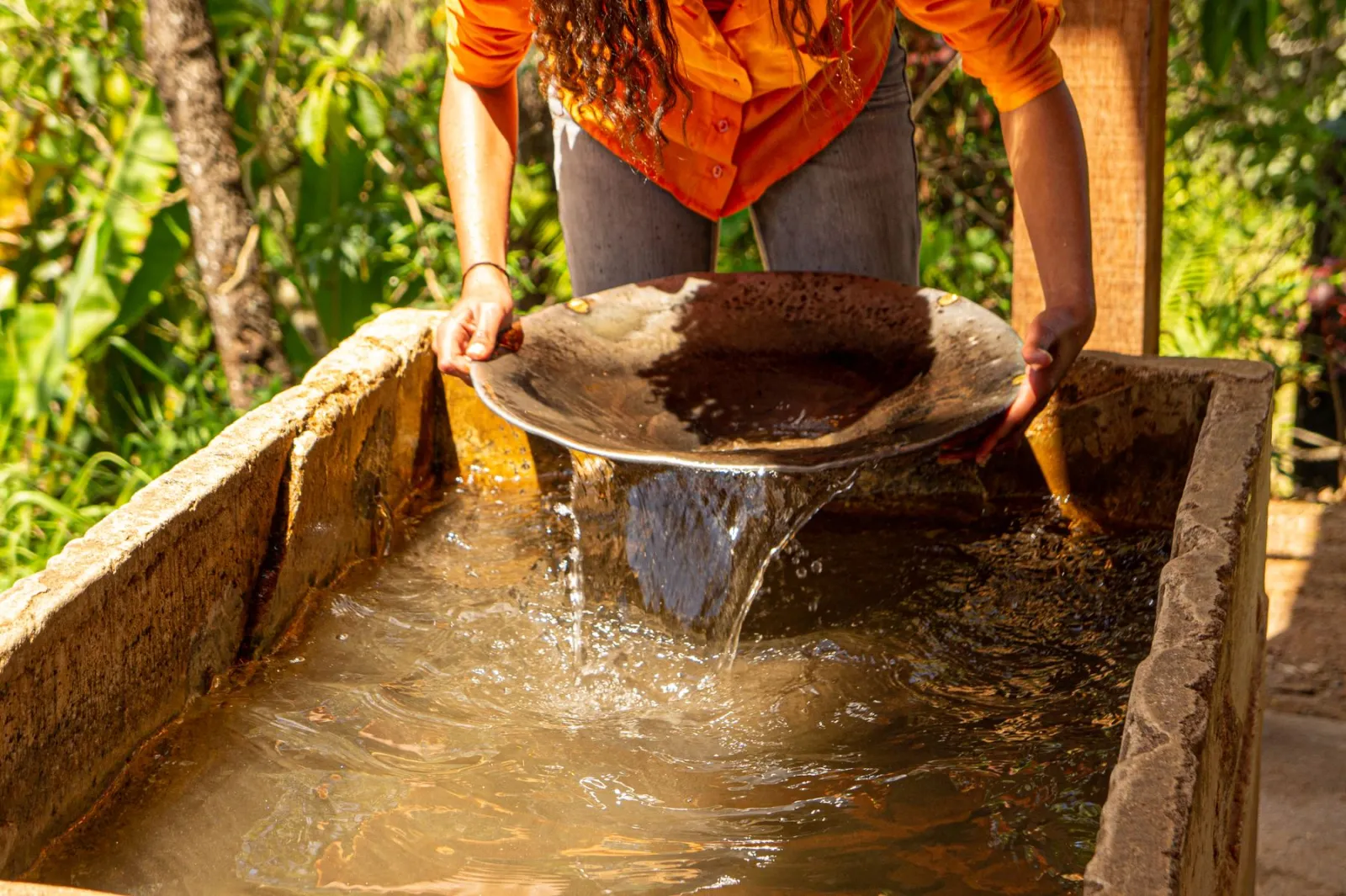
Flakes and small nuggets recovered from a river can be rinsed in clean water and kept in a small vial. If you go prospecting, first check the local rules, which govern where, when and with what equipment you may work: our guide to gold prospecting sets out the main points.
Sources
- Anthony J. W. et al., Handbook of Mineralogy, “Gold,” Mineralogical Society of America.
- Mindat.org, “Gold” (physical and chemical properties of native gold).
- U.S. Geological Survey, “Gold” (mineral commodity profile).