On a cold January morning in 1848, a carpenter building a sawmill in the Sierra Nevada foothills noticed a few shining flakes in the tailrace. Within a few years, that small find had drawn some 300,000 people to California, turned San Francisco into a city and helped make a remote territory the thirty-first state of the Union. Here is the story of the California Gold Rush: the discovery at Sutter’s Mill, the forty-niners and their routes, how the gold was mined, the people it displaced, and where to see the Mother Lode today.
In brief
- Gold was found on January 24, 1848, by James W. Marshall at Sutter’s Mill, in Coloma, on the South Fork of the American River.
- The great migration came in 1849, which is why the gold seekers are remembered as the forty-niners.
- California’s population of newcomers soared, and the territory became a state on September 9, 1850.
- The early gold was placer gold : flakes and nuggets in river gravels, first worked with pans and rockers, later with sluices, hydraulic jets and deep hard-rock mines.
The discovery at Sutter’s Mill
In 1847, John Sutter, a Swiss-born settler who ran a large agricultural colony near present-day Sacramento, hired James Marshall to build a water-powered sawmill at Coloma, about 45 miles (70 km) to the east. On January 24, 1848, while inspecting the mill’s tailrace, Marshall picked up several small pieces of yellow metal. Simple tests, including hammering a flake flat and boiling it in lye soap, convinced the mill crew it was gold.
The timing was remarkable. Only days later, on February 2, 1848, the Treaty of Guadalupe Hidalgo ended the Mexican–American War and transferred California to the United States. Neither side at the negotiating table knew that gold had just been found. Sutter tried to keep the discovery quiet, fearing for his ranch and his workers, but the secret did not last.
“Gold from the American River!”
In the spring of 1848, the San Francisco merchant Samuel Brannan, who had opened a store near Sutter’s Fort, is said to have walked through the town holding up a bottle of gold dust and shouting the news. Within weeks, San Francisco emptied as men left for the foothills, and sailors deserted their ships in the bay. Settlers from Oregon, Hawaii, Mexico and Chile were among the first to arrive.
The eastern United States remained skeptical until December 5, 1848, when President James K. Polk confirmed the reports in his message to Congress, and a sample of California gold went on display in Washington. That official seal of approval set off the rush of 1849.
The forty-niners and their routes
In 1849 alone, tens of thousands of people set out for California, from the eastern states and from Europe, Latin America, China and Australia. They were overwhelmingly young men, many of whom planned to make their fortune quickly and return home. There were three main ways to get there, each long, expensive and dangerous.
Overland by the California Trail
The cheapest route started from Missouri river towns such as Independence and St. Joseph and followed the trails across the plains, the Rockies and the Great Basin, roughly 2,000 miles (3,200 km). The journey by wagon took four to six months. Cholera, which swept the trails in 1849 and 1850, killed far more emigrants than any other hazard, and crossing the Sierra Nevada before the first snows was a race against time.
By sea around Cape Horn
From East Coast ports, ships sailed around the southern tip of South America, a voyage of some 18,000 miles that could last five to eight months. Hundreds of vessels abandoned in San Francisco Bay by crews who ran for the diggings were later used as warehouses, stores and even a jail, and some still lie buried beneath the city’s filled-in waterfront.
The Panama shortcut
The fastest option was to sail to the Isthmus of Panama, cross it by canoe and mule through the jungle, then wait for a ship north on the Pacific side. It could save months, but tropical diseases such as yellow fever and malaria made it deadly for many. The Panama Railroad, completed in 1855, eventually made the crossing much easier.
Life in the diggings
Mining camps sprang up along every promising river: the American, the Yuba, the Feather, the Stanislaus, the Tuolumne and their tributaries. Their names, such as Rough and Ready, Hangtown (today Placerville), Poker Flat or You Bet, still echo the period. There was little formal government at first, so miners drew up their own district rules, setting the size of a claim and how long it could be left unworked before someone else could take it over.
Life was hard. Prices for food, tools and lodging were extremely high, illness was common, and most miners earned little more than a laborer’s wage once costs were paid. The surest fortunes were often made by those who supplied the miners: merchants, shippers, bankers and innkeepers. Levi Strauss, who arrived in San Francisco in 1853 to sell dry goods, later patented riveted work trousers with the tailor Jacob Davis in 1873; the garment became the blue jean.
How California gold was mined
Pans, rockers and sluices
In 1848 and 1849, gold lay close to the surface in stream gravels and bars, where it had been concentrated over millions of years by the erosion of quartz veins. A single miner with a gold pan could recover it, and the richest gravels, the paydirt lying just above bedrock, paid handsomely at first. Miners soon moved to the rocker, or cradle, and then to the long tom and the sluice box, which let small teams wash far more gravel. Some companies diverted entire rivers with wing dams to work the exposed beds.
Hydraulic mining
As the easy gold ran out, attention turned to the ancient river channels buried in the hills. From 1853, miners in Nevada County began blasting these gravel banks with high-pressure jets of water fed through canvas hoses and iron nozzles. Hydraulic mining moved whole hillsides, but it sent enormous quantities of silt into the Sacramento Valley, choking rivers and flooding farms. In 1884, the federal court ruling in Woodruff v. North Bloomfield Gravel Mining Company, known as the Sawyer Decision, barred the dumping of mining debris into the rivers, which effectively ended large-scale hydraulic mining. The scarred cliffs of Malakoff Diggins still show its scale.
Hard-rock mining on the Mother Lode
The Mother Lode is a belt of gold-bearing quartz veins that runs for roughly 120 miles (190 km) along the western Sierra Nevada foothills. Following the gold back to its source meant sinking shafts, crushing ore in stamp mills and building a permanent industry. The Empire Mine at Grass Valley, one of the oldest and richest, worked hundreds of miles of tunnels and only closed in 1956.
What California gold looks like
Like all native gold, California gold is a natural alloy of gold and silver, never pure. Its fineness varies by district and is often lower than that of Western Australian gold, so some pieces look slightly paler. Most of the gold recovered was in flakes and small grains; nuggets weighing many ounces were found, especially in the early years, but they were always rare. The state is also known among collectors for crystallized gold, including leaf and dendritic forms: see our guide to natural gold crystals. In 1965, native gold was designated California’s official state mineral.
The human cost
The rush was a catastrophe for California’s Native peoples. Mining destroyed fishing streams and food sources, epidemics spread, and settlers and militias carried out repeated massacres, sometimes paid for with state funds. Historians estimate that California’s Native population, already reduced under Spanish and Mexican rule, fell from around 150,000 in 1848 to roughly 30,000 by 1870. In 2019, the state’s governor issued a formal apology, describing the violence as genocide.
Foreign miners also faced hostility. The Foreign Miners’ Tax of 1850 imposed a monthly fee aimed largely at Mexican, Chilean and other Latin American miners; it was repealed in 1851, then replaced in 1852 by a new tax that fell mainly on Chinese miners. Despite this, Chinese immigrants became one of the largest groups in the goldfields and went on to help build the transcontinental railroad.
The end of the rush and its legacy
California’s gold output peaked in the early 1850s. As surface deposits were exhausted, individual miners gave way to companies with capital and machinery, and the rush as a mass movement was largely over by the mid-1850s. Many forty-niners went home, others stayed as farmers, merchants or workers, and some followed news of new strikes to Nevada’s Comstock Lode, British Columbia’s Fraser River and Cariboo, and, half a century later, the Klondike Gold Rush in the Yukon.
The rush transformed the American West. San Francisco grew from a small port of around a thousand residents into a major city within a few years, California entered the Union in 1850, and the push to link the Pacific coast to the East led to the first transcontinental railroad in 1869. The state still carries the memory in its nickname, the Golden State, and in its motto, Eureka, “I have found it”. Mark Twain’s first success, “The Celebrated Jumping Frog of Calaveras County” (1865), was set in the old mining country, and the San Francisco 49ers take their name from the gold seekers.
Visiting gold country today
State Route 49, nicknamed the Golden Chain Highway, links many of the historic towns of the Mother Lode, from Mariposa in the south to Nevada City and beyond in the north. Several sites are preserved as California State Historic Parks:
- Marshall Gold Discovery State Historic Park, at Coloma, with a replica of Sutter’s Mill and Marshall’s monument;
- Columbia State Historic Park, a gold-rush town whose streets and buildings have been preserved;
- Empire Mine State Historic Park, in Grass Valley, for hard-rock mining;
- Malakoff Diggins State Historic Park, near Nevada City, for the landscape left by hydraulic mining.
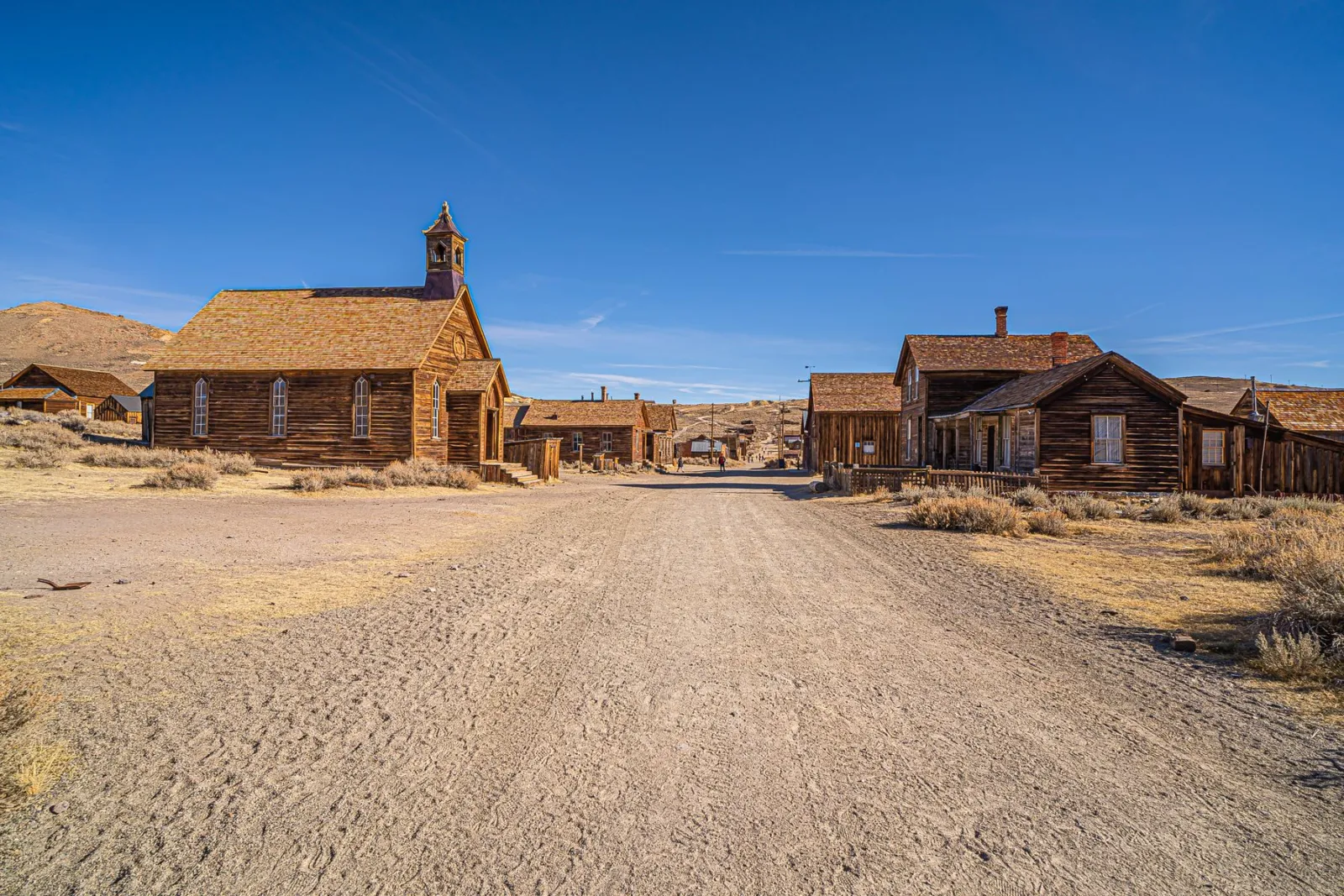
Bodie, in the eastern Sierra, belongs to a later chapter: a gold-mining boomtown of the late 1870s, now one of the best-preserved ghost towns in the West and a state historic park in its own right.
Recreational gold panning is still possible in California, but much of the best ground is under mining claims or private ownership, and suction dredging has been suspended in the state’s rivers since 2009. Some parks and private operators offer supervised panning; on federal land, check land status and claims with the Bureau of Land Management or the Forest Service before you dig. Our guide to gold prospecting in the United States explains the rules.
Most of what the forty-niners found was flakes. The large, solid nuggets that collectors seek today come mainly from Australia’s ancient goldfields. To hold a piece of native gold shaped by nature, each weighed, photographed and sold with its certificate, discover the collection.
Frequently asked questions
When did the California Gold Rush start and end?
Gold was discovered on January 24, 1848, and the mass migration followed in 1849. The rush peaked in the early 1850s and was largely over by around 1855, although gold mining continued in California for another century.
Where was gold first found in California?
At Sutter’s Mill in Coloma, on the South Fork of the American River, in what is now El Dorado County. The site is preserved in Marshall Gold Discovery State Historic Park.
Why are they called forty-niners?
Because most gold seekers arrived in 1849, the year after the discovery, once the news had been confirmed in the eastern United States and around the world.
Did most forty-niners get rich?
No. A few early arrivals made fortunes, but most miners earned modest sums once their high living costs were paid, and many lost money. Merchants and suppliers were often the real winners.
Is there still gold in California?
Yes. Rivers in the Sierra Nevada foothills still carry flakes, and hobby panners find gold every year, usually in small amounts. Land status, claims and state rules decide where you can prospect.
Sources and further reading
- California Department of Parks and Recreation, Marshall Gold Discovery, Columbia, Empire Mine and Malakoff Diggins State Historic Parks: parks.ca.gov
- US National Park Service, California National Historic Trail: nps.gov/cali
- California Geological Survey, gold in California and the state mineral: conservation.ca.gov/cgs
- Library of Congress, “The California Gold Rush” collections and primary sources: loc.gov
- Benjamin Madley, An American Genocide: The United States and the California Indian Catastrophe, 1846–1873 (Yale University Press, 2016).
- J. S. Holliday, The World Rushed In: The California Gold Rush Experience, a classic history based on forty-niners’ letters and diaries.