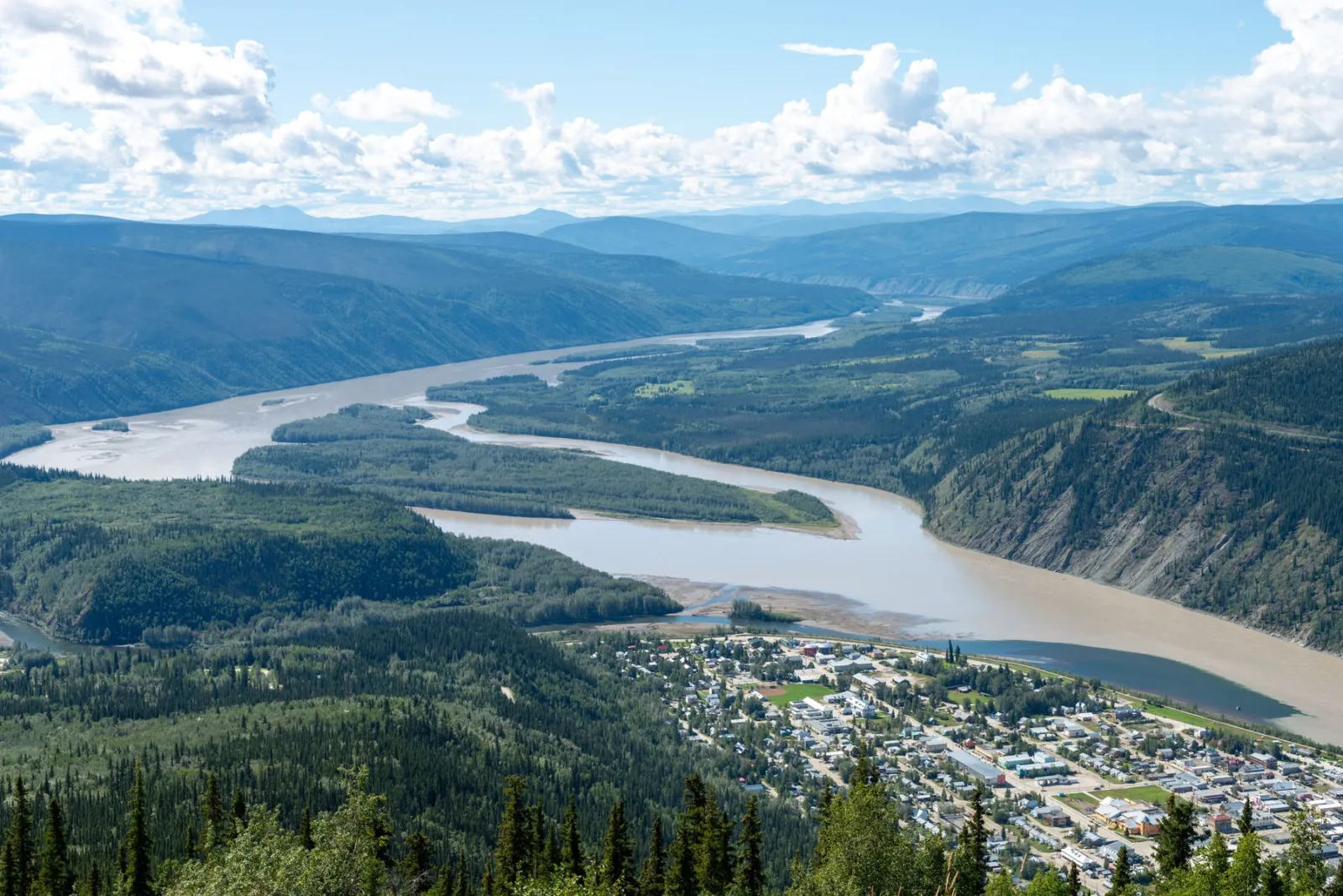
In the summer of 1896, a handful of prospectors found gold in a small creek of the Yukon, in Canada’s far northwest. Within two years, tens of thousands of people from the United States, Canada, Britain and beyond had set out for a place most of them could not find on a map. Here is the story of the Klondike Gold Rush: the discovery, the routes over the mountains, life in Dawson City, the gold itself, and what remains of it today.
In brief
- Gold was found in August 1896 on Rabbit Creek, soon renamed Bonanza Creek, a tributary of the Klondike River in the Yukon.
- The news reached the outside world in July 1897, when ships loaded with gold docked in San Francisco and Seattle.
- Roughly 100,000 people set out; only about 30,000 to 40,000 reached Dawson City, and a small minority found significant gold.
- Klondike gold is placer gold : flakes, coarse grains and nuggets held in frozen gravels, which miners had to thaw before they could work them.
The discovery on Bonanza Creek
Prospectors had been working the Yukon River basin for years before 1896, finding modest amounts of gold on the Fortymile and other streams. The decisive find came in mid-August 1896. George Carmack, an American, travelling with Keish, known as Skookum Jim Mason, and Káa Goox, known as Dawson Charlie, both Tagish men, panned rich gold from the bedrock of Rabbit Creek. The prospector Robert Henderson had earlier suggested the area to Carmack. The three men staked claims, and the creek was renamed Bonanza.
Word spread quickly among the miners already in the region, who abandoned their diggings and staked the creek from end to end within weeks. A neighboring tributary, Eldorado Creek, proved even richer: some of its claims became among the most productive placer ground ever worked in North America. The name Klondike itself comes from Tr’ondëk, the Hän name for the river, which refers to the stones used to anchor salmon traps. The Yukon still marks the discovery each year with Discovery Day, a territorial holiday in August.
“A ton of gold”: the news reaches the world
Because the Yukon was cut off by ice for most of the year, the outside world learned of the discovery almost a year later. In July 1897, the steamer Excelsior arrived in San Francisco, followed by the Portland in Seattle, carrying miners and their gold. Newspapers spoke of “a ton of gold”, and the timing could hardly have been better: the United States was emerging from the economic depression that followed the Panic of 1893, and many people had little to lose.
Within weeks, clerks, farmers, police officers and adventurers were buying outfits and booking passage north. Seattle, as the main supply point, grew rich selling equipment to the “stampeders”, as they came to be called, much as San Francisco had done during the California Gold Rush half a century earlier.
The routes to the Klondike
The Chilkoot and White passes
Most stampeders sailed up the Inside Passage to Southeast Alaska, landing at Dyea or Skagway. From Dyea, the Chilkoot Trail climbed steeply to the summit of the Chilkoot Pass; from Skagway, the longer White Pass trail became notorious as “Dead Horse Trail”, after the thousands of pack animals that died on it. The photograph of a single-file line of climbers on the snowy “Golden Stairs” of the Chilkoot remains the defining image of the rush.
The “ton of goods”
At the summits, the North-West Mounted Police guarded the Canadian border. To prevent famine in the Yukon, they required each person entering the territory to bring roughly a year’s worth of supplies, often summarized as a “ton of goods”. Since few could afford porters, most stampeders hauled their outfits up the passes in dozens of trips over several weeks.
Down the Yukon River
Beyond the passes, stampeders camped at Lake Lindeman and Lake Bennett through the winter of 1897–98, building boats from local timber. When the ice broke in late May 1898, thousands of craft set off on a journey of more than 800 kilometers (about 500 miles) down the Yukon River, through Miles Canyon and the Whitehorse Rapids, to Dawson City. Wealthier travellers took the “rich man’s route”: by sea to St. Michael, near the mouth of the Yukon in Alaska, then upriver by sternwheeler.
Dawson City, the “Paris of the North”
Founded at the confluence of the Klondike and Yukon rivers, Dawson City grew from a few tents into a town of perhaps 30,000 people by the summer of 1898. It had saloons, dance halls, theaters, banks and newspapers, along with high prices, poor sanitation and frequent fires. Unlike many American mining camps, it was relatively orderly: the North-West Mounted Police, led in part by Superintendent Sam Steele, enforced Canadian law, banned handguns in town and closed businesses on Sundays.
The rush also had a heavy cost for the Tr’ondëk Hwëch’in, the Hän-speaking people whose fishing camp stood at the mouth of the Klondike. Under Chief Isaac, they relocated downstream to Moosehide as the town took over their land. Their history is now central to how the region is presented: in 2023, the Tr’ondëk-Klondike landscape was inscribed on the UNESCO World Heritage List.
How Klondike gold was mined
Klondike gold is placer gold : particles released by the erosion of veins over millions of years and concentrated in stream gravels, especially just above bedrock. The difficulty was the permafrost. The ground stayed frozen year-round, so early miners lit wood fires to thaw it a few inches at a time, digging shafts and drifts along the pay streak through the winter. The gravel was piled in dumps and washed in sluice boxes when water flowed again in spring. Steam points, introduced later, made thawing faster.
After the rush, large companies consolidated the claims and brought in hydraulic methods and enormous bucket-line dredges. Dredge No. 4, on Bonanza Creek, is one of the largest wooden-hulled dredges ever built in North America and is today a Parks Canada National Historic Site.
What Klondike gold looks like
Like all native gold, Klondike gold is never pure: it is a natural alloy of gold and silver, with traces of other metals. Its fineness varies from creek to creek and is often lower than that of Australian gold, which gives some pieces a paler, more greenish-yellow tone. Read more in our guide to native gold composition. Most of the gold recovered was in flakes and coarse grains; nuggets were found, some of them large, but they were the exception, as they are on every goldfield.
The end of the rush
By the time most stampeders reached Dawson in 1898, the richest ground had long been staked by those already in the region. Many sold their outfits and went home without ever panning a claim. In 1899, news of gold on the beaches of Nome, Alaska, drew thousands away, and Dawson’s population fell rapidly. The White Pass & Yukon Route railway, completed in 1900, arrived just as the rush ended. For a few, the Klondike brought fortunes; for most, it was an extraordinary adventure that cost them their savings. Merchants, outfitters and transport companies were often the surest winners.
The rush left a deep mark on culture: Jack London drew on his winter in the Yukon for his stories, Robert Service, who arrived in Dawson a decade later, wrote ballads such as “The Cremation of Sam McGee”, and Charlie Chaplin’s 1925 film The Gold Rush made the Chilkoot climb famous worldwide. It also accelerated the development of Alaska and the Yukon, which became a separate territory of Canada in 1898.
Visiting and prospecting in the Klondike today
Placer mining remains an active industry in the Klondike, and the creeks are still largely covered by mining claims. Placer and quartz claims in the Yukon are governed by territorial legislation and recorded with the Yukon government’s mining recorder; prospecting on someone else’s claim, or on First Nation Settlement Land, without permission is not allowed. Visitors who want to try panning can use designated public sites, such as the free panning claim maintained on Bonanza Creek near Dawson City. Rules and locations change, so check current information with the Government of Yukon and local visitor centers before you go, and see our general guide to gold prospecting.
History is easy to follow on the ground: the Klondike Gold Rush National Historical Park, managed by the US National Park Service, preserves Skagway and the Chilkoot Trail on the Alaska side and has a visitor center in Seattle; on the Canadian side, Parks Canada manages the Chilkoot Trail, Dredge No. 4 and the historic buildings of Dawson City. Hiking the Chilkoot Trail requires a permit and careful preparation.
Today, the large nuggets that stampeders dreamed of come mostly from Australia’s ancient goldfields. To hold a piece of native gold shaped by nature, each weighed, photographed and sold with its certificate, discover the collection.
Frequently asked questions
When did the Klondike Gold Rush happen?
Gold was discovered in August 1896, but the rush itself began in July 1897, when the news reached San Francisco and Seattle. It peaked in 1898 and was largely over by 1899, when many miners left for Nome, Alaska.
Is the Klondike in Alaska or Canada?
In Canada. The Klondike River and Dawson City are in the Yukon. Most stampeders, however, landed in Alaska, at Skagway or Dyea, before crossing the mountain passes into Canada, which is why the rush is closely tied to Alaska’s history.
How many people found gold in the Klondike?
Of roughly 100,000 people who set out, about 30,000 to 40,000 reached Dawson City. Only a few thousand actually worked for gold, and a much smaller number became rich. Many of the best claims had been staked before the main wave arrived.
Can you still pan for gold in the Klondike?
Yes, at designated public sites near Dawson City. Elsewhere, most ground is under active mining claims, and you need the claim holder’s permission. Check current rules with the Government of Yukon before prospecting.
Were large nuggets found in the Klondike?
Some were, but most Klondike gold was recovered as flakes and coarse grains. The world’s record nuggets come chiefly from Australia: see the largest gold nuggets in the world and Australian gold.
Sources and further reading
- US National Park Service, Klondike Gold Rush National Historical Park (Skagway and Seattle): nps.gov/klgo
- Parks Canada, Klondike National Historic Sites (Dawson City, Dredge No. 4, Chilkoot Trail): parks.canada.ca
- Government of Yukon, Energy, Mines and Resources (placer mining and claims): yukon.ca
- UNESCO World Heritage Centre, Tr’ondëk-Klondike (inscribed 2023): whc.unesco.org
- Pierre Berton, Klondike: The Last Great Gold Rush, 1896–1899, the classic narrative history.