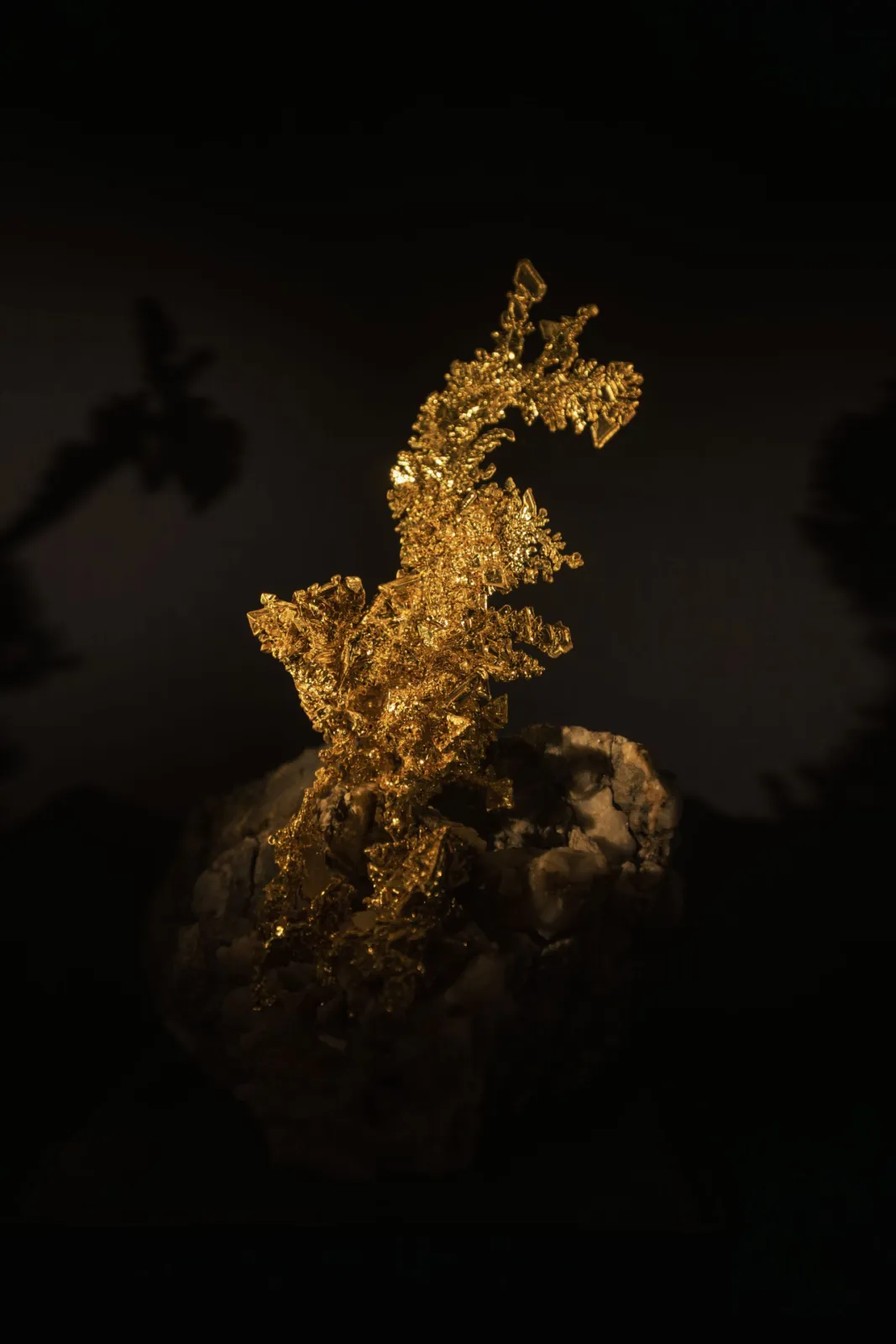
Every gold nugget is a piece of native gold: gold found in nature as metal, never melted or refined by human hands. The term appears on every listing in our collection. Here is exactly what it means, what native gold is made of, and where it forms.
In brief
- Native gold is a mineral: the element gold (Au) in its metallic state, as nature deposited it.
- It is never 100% pure: it is a natural alloy, mostly with silver, sometimes with copper or palladium.
- It occurs in lode deposits (quartz veins) and in placer deposits (stream and river gravels).
- Flakes, nuggets, crystals and gold in quartz are four faces of the same mineral.
What does “native” mean?
In mineralogy, an element is called native when it occurs on its own, as metal, rather than combined with other elements in an ore. Gold is one of the few metals found this way, alongside silver, copper and platinum. Most metals, such as iron, zinc or lead, exist only as oxides or sulfides and must be extracted chemically.
This stability comes from gold’s chemistry: it does not oxidize, tarnish or react with most acids. A nugget that has lain in a creek for thousands of years comes out as bright as the day it formed, which immediately sets it apart from look-alikes such as pyrite, or fool’s gold.
What is native gold made of?
Native gold almost always contains silver, in proportions that vary from one deposit to another. Placer nuggets commonly assay between 80 and 95% gold, and some Australian nuggets run higher. Above roughly 20% silver, the alloy is called electrum: paler, with a greenish-yellow tint. Traces of copper, iron, mercury or palladium may also be present. Composition affects color, density and, of course, metal value.
Properties that identify it
| Property | Native gold |
|---|---|
| Specific gravity | 15 to 19.3 depending on silver content (19.3 for pure gold) |
| Hardness (Mohs) | 2.5 to 3: a steel point scratches it |
| Malleability | Extreme: it flattens without breaking |
| Streak | Golden yellow |
| Weathering | None: no rust, no tarnish |
| Crystal system | Cubic (octahedra, dendrites, leaf gold) |
Density is the most telling clue: a nugget always feels surprisingly heavy for its size. Our guide on how to tell a real gold nugget shows how to use these properties in practice.
Where does native gold form?
Lode deposits
Gold is first carried by hot fluids circulating through fractures in the Earth’s crust. As they cool, these fluids deposit quartz and, sometimes, gold. This is the origin of gold-in-quartz specimens and of most natural gold crystals, which could grow undisturbed in open cavities.
Placer deposits
Erosion then frees gold from its host rock. Being so dense, it concentrates in the gravels of modern and ancient streams, where it becomes rounded as it travels. This is where water-worn nuggets and the flakes prospectors pan for are found. The full process is explained in how gold nuggets form.
The forms of native gold
- Flakes: tiny flat particles, the most common gold in streams (see gold flakes vs. nuggets).
- Nuggets: masses of gold from a few millimeters to several centimeters, rounded or angular.
- Crystals: octahedra, hoppers, dendrites or leaf gold, the rarest forms.
- Gold in quartz: gold still held in its host rock.
All of these forms are in our collection: gold nuggets, gold crystals and gold in quartz, each piece weighed and sold with its certificate.
Frequently asked questions
Is native gold pure gold?
No. It is a natural alloy, usually with silver. Purity varies by deposit, typically 80 to 95% for placer nuggets.
How is native gold different from bullion?
Bullion bars and coins have been melted and refined to a guaranteed fineness. Native gold remains as nature formed it, so its value combines metal content and a rarity premium, as explained in are gold nuggets an investment?
Sources
- Mindat.org, “Gold” mineral data.
- U.S. Geological Survey, gold mineral resources.
- Encyclopædia Britannica, “Gold”.