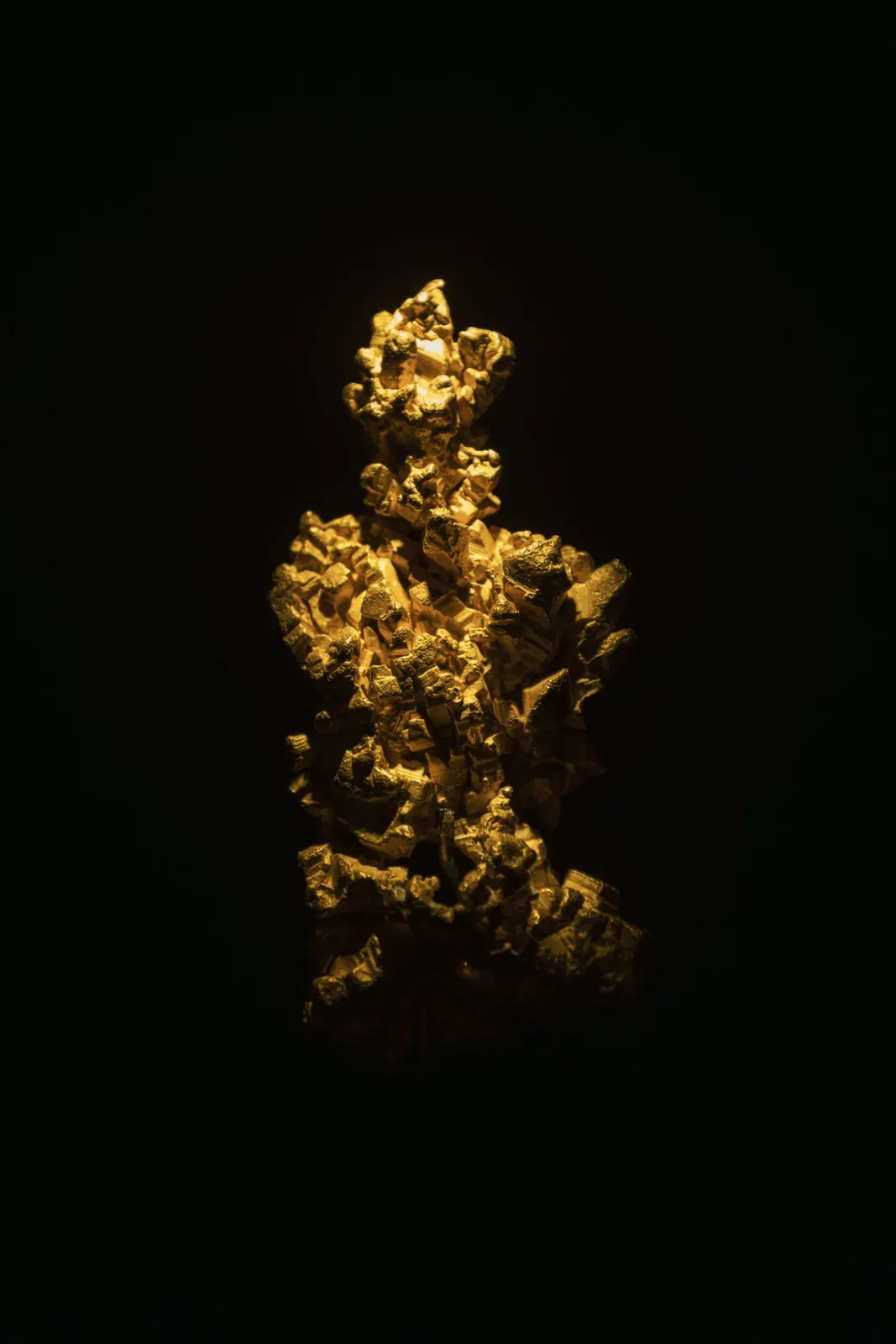
“I found gold in the creek!” Most of the time, that means flakes, not nuggets. Both are native gold, but their size, weight and rarity are worlds apart. Here is how prospectors and collectors tell them apart.
In brief
- A flake is a tiny flat sliver of gold, weighing about a milligram or less.
- A picker is a piece large enough to pick out of the pan with tweezers or fingers.
- A nugget is a solid mass of gold that can be weighed on its own.
- There is no official threshold: these terms come from prospectors’ and dealers’ usage.
The vocabulary of placer gold
| Form | Appearance | Typical size | Where found |
|---|---|---|---|
| Fine gold (“flour”) | Barely visible specks | Under 0.5 mm | Most placers |
| Flake | Flat, bright sliver | About 0.5 to 2 mm | Rivers across the US, Canada, UK and Europe |
| Picker | Thick grain, easy to pick | About 2 to 5 mm | Richer placers |
| Nugget | Rounded or angular mass | A few mm to several cm | Australia, Alaska, Yukon… |
These ranges are indicative: a single cleanup can mix flakes and pickers, and the line between a large picker and a small nugget is a matter of judgment. For weight references, see our gold nugget size and weight guide.
Why are gold flakes flat?
Gold is extraordinarily malleable. Carried for miles among cobbles, a small fragment is hammered again and again until it flattens into a flake. The farther gold has traveled from its source, the finer and flatter it is. An angular nugget, perhaps still holding a bit of quartz, has traveled little and settled close to its vein, as explained in how gold nuggets form.
How many flakes make a gram?
A flake one millimeter across and a few hundredths of a millimeter thick weighs roughly a milligram, often less. It takes hundreds or even thousands of flakes to make a gram, and about 31 grams to make a troy ounce. That is why a day’s prospecting is measured in flakes, and why a single one-gram nugget is already a fine piece.
Flakes in most rivers, nuggets in Australia
Many classic panning streams, from California to Wales, drain terrain where gold is scattered in fine particles: they yield mostly flakes. The great goldfields of Australia, by contrast, hold solid nuggets, sometimes enormous ones, found mainly by metal detector. That is where most of our collection comes from, as explained in our guide to Australian gold.
What is a flake worth, and a nugget?
Flake gold is valued essentially for its metal, minus refining costs. A nugget adds a rarity premium to its metal value, tied to its size, shape and origin. The larger and finer the nugget, the more that premium counts, as detailed in how gold nugget prices are calculated.
For a first purchase, our gold nugget lots balance budget and enjoyment; individual nuggets suit a gift or a collection better.
Frequently asked questions
Are gold flakes worth anything?
Yes, the value of the gold they contain, but in very small amounts. Their real appeal is the hobby and the thrill of the find.
How should I store gold flakes?
In a small glass vial filled with water, which shows them off and magnifies them. Nuggets are better kept dry in a case, as explained in how to clean and store gold nuggets.
Sources
- U.S. Geological Survey, placer gold deposits.
- Geological Survey of Victoria, goldfields and nuggets.