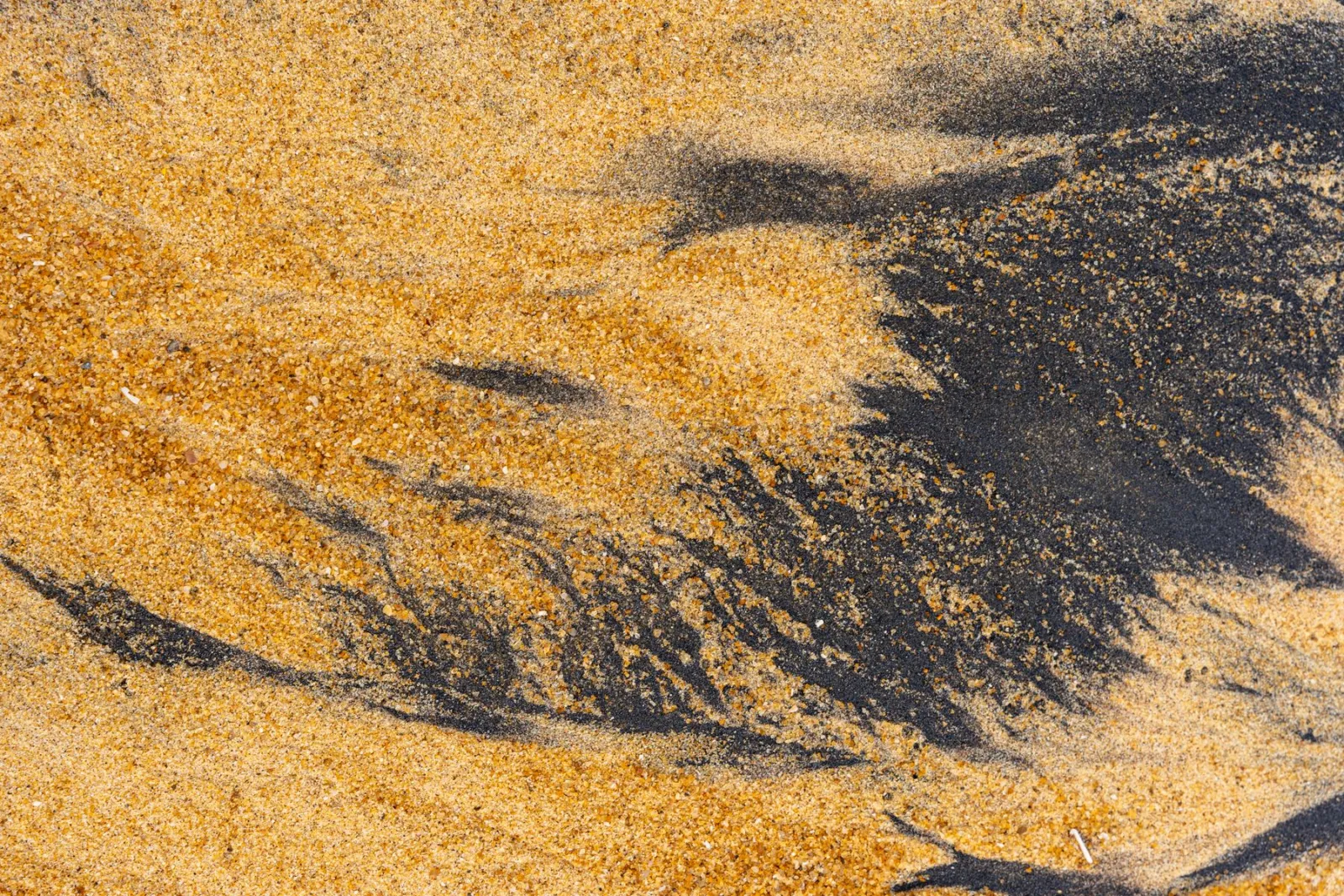
Anyone who has panned a gold-bearing stream knows the moment: the light gravel has washed away, and the bottom of the pan is covered in a dark, heavy sand with, if you are lucky, a few specks of yellow in it. That black sand is the prospector’s constant companion. Here is what black sand is made of, why it travels with gold, what it can and cannot tell you, and how gold is separated from it, from the pan to the magnet.
In brief
- Black sand is a mix of heavy minerals, mainly magnetite, hematite and ilmenite, often with garnet, zircon and other dense grains.
- It is about twice as dense as ordinary quartz sand, so water sorts it into the same places as gold: on bedrock, in crevices and behind obstacles.
- Black sand is a useful indicator, not a guarantee: plenty of black sand holds no gold at all.
- Gold is separated from it by careful panning, screening, a magnet and water-based tools; mercury should never be used.
What black sand is made of
“Black sand” is a field term, not a single mineral. It describes the dark, dense fraction left behind when lighter minerals such as quartz and feldspar are washed out of stream gravel. Its exact recipe depends on the rocks upstream, but the same minerals turn up again and again.
The iron oxides
Magnetite is usually the main ingredient. It is black, has a specific gravity of about 5.2 and is strongly magnetic, which is why a magnet pulls so much of a concentrate away. Hematite, another iron oxide, is similar in density but only weakly magnetic, and leaves a reddish-brown streak. Ilmenite, an iron-titanium oxide with a specific gravity of about 4.7, is weakly magnetic and common in sands derived from volcanic and metamorphic rocks.
The colorful companions
Many concentrates also contain red to pink garnet, which prospectors call “ruby sand”, along with zircon, rutile, monazite or chromite, depending on the local geology. In some districts, very dense grains of cassiterite (tin ore) or even platinum-group metals appear. None of these is gold, but each is heavy enough to end up in the same place.
Why black sand and gold travel together
Gold is released from quartz veins by weathering, as explained in our guide to how gold nuggets form. The heavy minerals in black sand are released from their host rocks in the same way. Once in a stream, every grain is sorted by density: ordinary quartz sand has a specific gravity of about 2.65, black sand minerals about 4.5 to 5.3, and native gold roughly 15 to 19 depending on its silver content.
When the current slows, on an inside bend, behind a boulder or over a bedrock crack, the heaviest particles drop first and work their way down through the gravel during floods. Over time this builds layers rich in black sand, and if there is gold in the system, it tends to sit with them. That is why the black streaks you see on a gravel bar, or in a riffle after high water, are worth a test pan. The richest of these layers is what miners call paydirt.
What black sand can and cannot tell you
A strong concentration of black sand shows that the stream is sorting heavy minerals effectively at that spot. It is a good place to sample. But it says nothing certain about gold: many rivers carry abundant magnetite from volcanic or iron-rich rocks and no gold at all. Prospectors treat black sand as a signpost, then confirm with test pans, counting the “colors” (visible gold particles) in each one.
Be cautious, too, with claims that black sand contains large amounts of “invisible” or “microscopic” gold that ordinary methods cannot see. Such claims have circulated for well over a century. Real gold in a concentrate can be recovered and seen under magnification, and a reputable assay laboratory can measure it. If someone offers to sell you black sand at a high price on the strength of an unverified assay, ask for the laboratory’s name and method, or walk away.
How to separate gold from black sand
Most hobby prospectors collect their black sand concentrates through the season and clean them up at home, where it is easier to work slowly. The methods below are usually combined.
1. Screen (classify) the concentrate
Gold separates much more easily from grains of a similar size. Pass the dry or wet concentrate through a series of screens, for example 30 mesh (openings of about 0.6 mm, or 0.02 in), 50 mesh (about 0.3 mm) and 100 mesh (about 0.15 mm), and process each size fraction separately. Pick out any visible flakes from the coarse fraction by hand.
2. Finish in the pan
A smaller, smooth-bottomed finishing pan with fine riffles works best. Add water, settle the material with a gentle shake, then tilt and swirl so the black sand fans out ahead of the gold. Gold, being three to four times denser than the black sand, lags behind as a yellow “tail”. The basic motion is described in our guide on how to pan for gold. A drop of biodegradable dish soap in the water helps fine gold sink instead of floating on surface tension.
3. Use a magnet, carefully
Gold is not magnetic, so a magnet can strip out most of the magnetite. Put the magnet inside a plastic bag, pass it over the wet concentrate, then pull the magnet out of the bag over a separate container to drop the magnetic fraction. Working wet matters: dry magnetite grains clump and can drag fine gold with them. Always pan the magnetic fraction once more before discarding it, because small flakes are easily trapped.
4. Water-based cleanup tools
For larger volumes of concentrate, hobbyists use small mechanical aids. A vortex bowl fed by a gentle stream of water spins light material out over the rim while gold stays at the center. A spiral wheel concentrator uses a rotating, tilted pan with spiral riffles that carry gold to a central hole. Small cleanup sluices with fine matting do a similar job on a bench; the principle is the same as in a full-size sluice box.
5. Never use mercury
Historically, miners used mercury to amalgamate fine gold out of black sand. Mercury is highly toxic to people and to aquatic life, and its use in gold mining is targeted by the international Minamata Convention on Mercury. It has no place in a hobby cleanup. Patience, good screening and the tools above recover fine gold safely.
Black sand beaches and beach gold
Black sand is not confined to rivers. Waves sort heavy minerals on beaches too, leaving dark streaks along the shoreline after storms. Some of these beach placers have carried gold. The town of Gold Beach in southern Oregon takes its name from gold found in coastal sands in the 1850s, and in 1899 and 1900 thousands of people worked the gold-bearing beach sands at Nome, Alaska, where garnet-rich “ruby sand” was a sign of pay. The West Coast of New Zealand’s South Island has similar gold-bearing beach sands.
The famous black sand beaches of Hawaii and Iceland, by contrast, are made of volcanic basalt fragments and glass, not gold-bearing placers. They are also protected: removing sand from beaches is prohibited in Hawaii and restricted in many other places. On a larger scale, heavy mineral sands are mined commercially around the world, but for titanium minerals and zircon rather than gold.
Rules and good practice
Collecting black sand concentrates is subject to the same rules as any prospecting: permission from the landowner or claim holder, local limits on tools, and seasonal closures that protect fish spawning gravels. Requirements vary between the US, Canada, the UK and Australia; our gold prospecting guide gives an overview with country pages. Fill your holes, leave the streambank as you found it, and keep any discarded concentrate out of the water where it could cloud spawning beds. The basic equipment is listed in our gold panning kit guide.
Most gold recovered from black sand is fine: dust and small flakes rather than nuggets, as explained in our guide to gold flakes vs. gold nuggets. If you would rather own a natural nugget with a known weight and origin, every Aurum Native piece is photographed and sold individually. Discover the collection.
Frequently asked questions
Is black sand worth anything on its own?
For a hobbyist, usually not. Magnetite and the other common black sand minerals are abundant and have little value in small quantities. The value of a concentrate lies in any gold or other precious metal it actually contains, which only careful cleanup or a proper assay can establish.
Does black sand always mean gold is nearby?
No. It means heavy minerals are being concentrated there, which makes it a good place to test. Many streams rich in black sand carry no gold. Only test pans can tell you.
How can I tell gold from shiny grains in black sand?
Gold stays bright yellow from every angle, stays behind when you swirl the pan, and is soft enough to flatten under a pin. Pyrite and weathered mica glint only in certain light, wash away more easily and break or flake. Our guide to fool’s gold vs. real gold covers the differences in detail.
Can a metal detector find gold in black sand?
Not the fine gold it usually contains, which is far too small for a detector. Black sand also creates “ground noise” that interferes with detectors, which is why gold detectors include ground-balance settings. See our guide to metal detecting for gold.
Sources
- US Geological Survey, placer gold deposits and heavy mineral sands.
- Mindat.org, mineral data for magnetite, ilmenite, hematite and gold (specific gravity, magnetism).
- Oregon Department of Geology and Mineral Industries, coastal black sand placers.
- Alaska Division of Geological & Geophysical Surveys, Nome beach placers.
- UN Environment Programme, Minamata Convention on Mercury (artisanal gold mining).