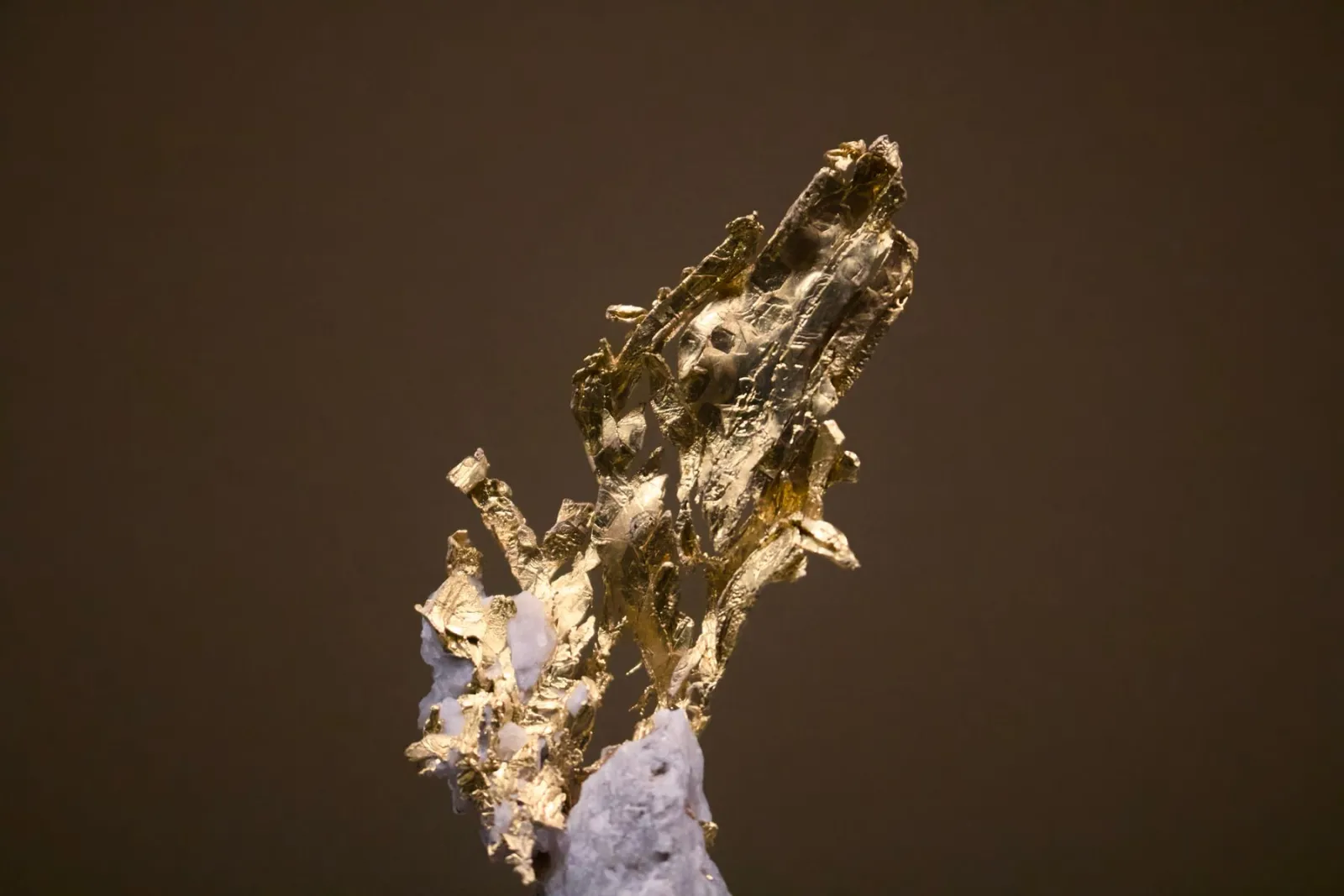
A gold nugget is the outcome of a very long geological story: hot fluids circulating several kilometers underground, veins of quartz, then millions of years of erosion and transport. Understanding how a gold nugget forms is also understanding why each piece has a shape, a color and a composition all its own.
In brief
- Gold is most often born in quartz veins, deposited by hot fluids rising along major faults (see our guide to gold quartz specimens).
- Over time, erosion frees the gold from its rock; being very dense, it concentrates in soils and ancient riverbeds known as “placers.”
- The journey downstream rounds and hammers the gold: the farther a nugget has traveled, the smoother it is.
- Some gold may also dissolve and redeposit near the surface, a process still being studied by researchers.
Stage one: gold from the depths
In the Earth’s crust, gold is extremely dilute: a few parts per billion on average. To become visible, it must be concentrated thousands of times over. This work is done by hydrothermal fluids: hot waters laden with salts, sulfur and carbon dioxide that circulate through deep rock at temperatures of around 250 to 400 °C.
These fluids form mainly during major plate collisions, when rocks are buried, heated and deformed. They leach gold scattered through vast volumes of rock and carry it in solution, bound to sulfur or chlorine. Geologists call the result orogenic gold deposits : these gave rise to the great goldfields of Victoria and Western Australia, as well as California’s Mother Lode and many other gold belts around the world.
The role of faults and quartz
The fluids rise through faults and fractures. When they meet a sudden drop in pressure, a fall in temperature or a rock that reacts chemically with them, they can no longer hold their load in solution. Silica precipitates as quartz, gradually filling the fracture to form a vein. Gold is deposited at the same time, as grains, plates or wires within the quartz, often alongside pyrite and other sulfides.
That is why so many specimens still pair the two minerals: white or milky quartz serves as a setting for yellow gold. The pieces in our gold in quartz selection show this association exactly as it formed in the vein.
A recent lead: electricity in quartz
One question long puzzled geologists: how can fluids so poor in gold produce masses of gold weighing tens of kilograms in a single vein? A study published in 2024 in the journal Nature Geoscience by a team from Monash University in Australia offers an experimental explanation. Quartz is a piezoelectric mineral: under stress, as during an earthquake, it generates a small electrical voltage. In the laboratory, this voltage is enough to precipitate dissolved gold onto the surface of quartz, then to concentrate the deposit on existing gold grains, which act like lightning rods. Earthquake after earthquake, gold would thus accumulate in the same place. The hypothesis has yet to be confirmed in the field, but it sheds light on how large masses of vein gold form.
Stage two: erosion sets the gold free
Over millions of years, a vein formed several kilometers down can be brought toward the surface as mountains rise and landscapes wear away. Exposed to rain, frost and changing temperatures, the quartz cracks and breaks down. Sulfides weather into iron oxides, which give some nuggets their brown or rust-colored tints. Gold, however, does not oxidize: it emerges from the rock intact.
Its density then becomes decisive. Pure gold is 19.3 times heavier than water, native gold generally between 15 and 19 depending on its silver content, compared with about 2.7 for quartz. Once released, it stays close to its source or creeps slowly downslope, concentrating in deposits known as placers :
- Eluvial placers : the gold stays in place, or nearly so, in the soil covering the vein. Nuggets here are angular and rough, often still attached to fragments of quartz.
- Colluvial placers : the gold has slid down the slopes. It has lost part of its host rock but keeps irregular shapes.
- Alluvial placers : the gold has been carried by streams and has collected where the current slows, at the bottom of gravels, on bedrock, or in ancient riverbeds now buried.
Stage three: transport shapes the nugget
Gold is a highly malleable metal. Tumbled among pebbles, it does not break: it bends, folds and flattens. Edges soften, cavities partly close, the surface is hammered. The longer the journey, the more compact, rounded and smooth the nugget becomes. The smallest particles end up as flat flakes , the kind still recovered with a gold pan from rivers today, as described in our guide to gold prospecting.
The shape of a nugget therefore tells its story. A piece bristling with relief, its hollows filled with quartz, has traveled little and comes from a deposit close to the vein. A smooth, bright nugget has been polished at length by water. The large nuggets of Australia, often found at shallow depth near their source, frequently show this raw character; our page on Australian gold describes these very ancient terrains.
Can nuggets grow?
Since the nineteenth century, prospectors have been puzzled to find nuggets in placers larger than any gold visible in nearby veins. Two ideas long competed: either nuggets are simply fragments of veins, or they partly grew in place, near the surface.
Current research shows that most nuggets do originate in veins: their internal structure preserves crystals and deformation inherited from depth. Their surface, however, has often been modified. A thin rim of purer, silver-depleted gold is frequently observed, the silver having been dissolved by groundwater. Research in Australia has also identified gold grains associated with bacterial biofilms, in particular the bacterium Cupriavidus metallidurans, which can precipitate dissolved gold. These so-called supergene or biogenic processes can rework a nugget’s surface and form tiny grains of secondary gold; on their own, they do not explain very large masses.
Why native gold is never pure
In deep fluids, gold travels with silver, which is deposited alongside it to form a natural alloy. The proportion of silver depends on the deposit and the temperature of deposition: it ranges from a few percent to more than 20%, beyond which the alloy is called electrum, paler in color. Traces of copper, mercury or palladium may also be present. This composition accounts for the variations in color from one nugget to another and is part of the calculation of its value, as explained in our guide to the price of a gold nugget. It is also one of the clues to tell a real gold nugget : a piece assaying 99.9% is suspected of having been melted.
The case of gold crystals
Gold crystallizes in the cubic system. When it is deposited slowly in an open cavity in the vein, free of constraint, it can develop true crystals : octahedra, hopper crystals with recessed faces, fern-like dendrites, or twisted wires known as wire gold. These delicate forms do not survive transport in a river; they are found in primary deposits or in placers that remained very close to their source. Their rarity explains the special place of gold crystals among collectors.
Reading a nugget’s history
- Embedded quartz, sharp edges : a nugget close to its vein, little transported.
- Smooth surface, rounded forms : long transport in a river.
- Brown or red patina : iron oxides from weathered sulfides, on the surface only.
- Geometric faces, wires, dendrites : crystal growth in an open cavity.
Every piece in the collection is photographed and described individually, with its provenance, so you can trace these clues on the nugget itself. Discover our gold nuggets.
Frequently asked questions
How long does it take for a gold nugget to form?
There is no single answer. The deposition of gold in a vein can span thousands to millions of years, and its release by erosion then takes millions more. The gold in Western Australia’s great deposits was laid down about 2.6 billion years ago.
What is the difference between a nugget and a flake?
It is a matter of size and shape. Flakes are fine, flattened particles, often smaller than a millimeter, transported over long distances by water. A nugget is a solid piece of gold visible to the naked eye, generally from a few tenths of a gram upward.
Why is gold found in rivers?
Because rivers drain landscapes where ancient gold-bearing veins reach the surface. Gold torn from the rock, being very dense, settles where the current slows: on the inside of bends, in hollows in the bedrock, behind large boulders.
Can a nugget form in just a few years?
No. Surface processes can deposit very thin layers or tiny grains of gold, but a nugget of several grams is the product of a very long geological history.
Sources
- Groves D. I. et al., “Orogenic gold deposits,” Ore Geology Reviews, 1998.
- Reith F. et al., “Biomineralization of gold: biofilms on bacterioform gold,” Science, 2006.
- Voisey C. R. et al., “Gold nugget formation from earthquake-induced piezoelectricity in quartz,” Nature Geoscience, 2024.
- U.S. Geological Survey, “Gold” (mineral profile and gold deposits).